VOTE FOR A FUTURE CATEGORY
Plants & Trees
Flowers, ferns, cacti and towering trees.
TOWERS, STATUES, BRIDGES & ARENAS · FIVE ROUNDS A DAY · 80 LANDMARKS
Turn your phone upright
The board needs the height.
Slide left or right anywhere on the board to resize the white silhouette. Arrow keys resize it a step at a time, Enter locks in your guess.
Slide anywhere on the board to resize · then Lock inSlide anywhere on the board to resize
0out of 1,000
Pick the category you’d most like to play. Votes help us choose what to build next; nothing here is playable yet.
Flowers, ferns, cacti and towering trees.
Balls, rackets, boards and goals from your favourite sports.
Flutes, guitars, drums and grand pianos.
Bacteria, cells, pollen and tiny organisms — explore sizes under a microscope.
Loading your vote…
Have another theme in mind?
Want something new on the table?
01 / Familiar places, surprising proportions
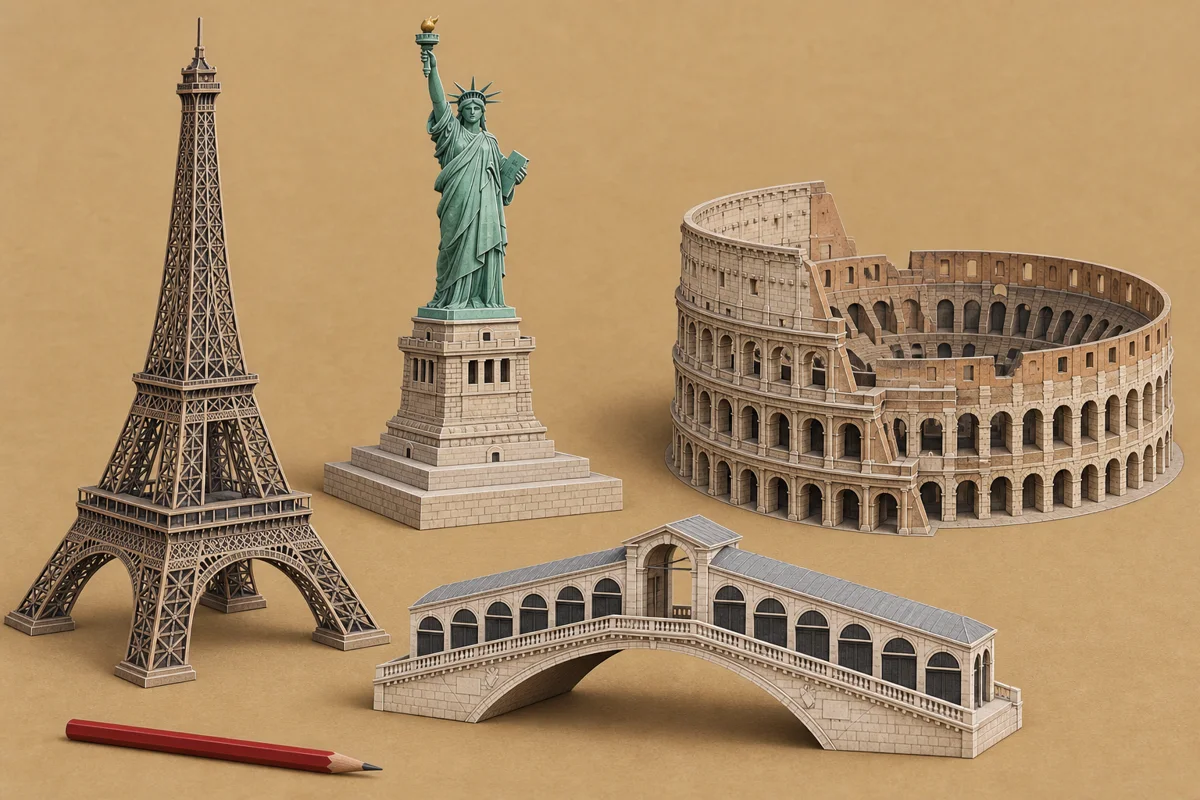
You recognise the Eiffel Tower. You have seen the Statue of Liberty in films. But could you put either next to a skyscraper and get the scale right? Size It Up Landmarks turns familiar places into a test of proportion.
Size It Up Landmarks brings 80 human-built structures onto one board: towers, statues, monuments, bridge main spans and arenas. Famous does not always mean enormous. A small-looking outline can represent hundreds of metres, while an imposing monument can be much shorter than you remember.
The challenge is visual estimation backed by a named measurement. You do not need an architecture degree, and you do not need to know every answer. Start with the reference, make a reasoned guess and learn from the reveal.
02 / Read, compare, commit
Size It Up Landmarks gives you five Daily rounds. Everyone playing that date receives the same pairs. Unlimited keeps drawing fresh pairs from this category, with five, ten, twenty or endless rounds available.
In Size It Up Landmarks, the black object is your reference. Its displayed measurement is known. Resize the cream target to the size you believe is correct, then submit. The live number is your current estimate, not the answer. Metres and feet describe the same span; changing your mental unit does not change the score.
In Size It Up Landmarks, “main span” and “total length” mean different things. Check the qualifier beneath each name before moving the target.
Try half, twice or three times the reference. Drag the corner handle, move the ruler control or use the size buttons to refine your estimate.
Read the true size after submitting. After the fifth reveal, use See final score to view the complete result. Share a round or challenge a friend from the result controls.
03 / What are we measuring?
Size It Up Landmarks scores one dimension at a time. Most towers use height. A bridge can use its main span. An amphitheatre can use the long axis of its exterior oval. Height and length are both distances, so a round may compare different named axes.
An antenna, spire, pedestal or lantern can change the answer. The object qualifier defines which parts count. Liberty includes her pedestal; the Statue of Unity entry measures the figure alone. The Florence Cathedral entry stops at the lantern, excluding the ball and cross above it.
Read each entry as a specific measurement of a specific structure. Size It Up Landmarks does not ask you to estimate floor area, volume, capacity, elevation above sea level or the number of storeys.
04 / One bridge, several lengths
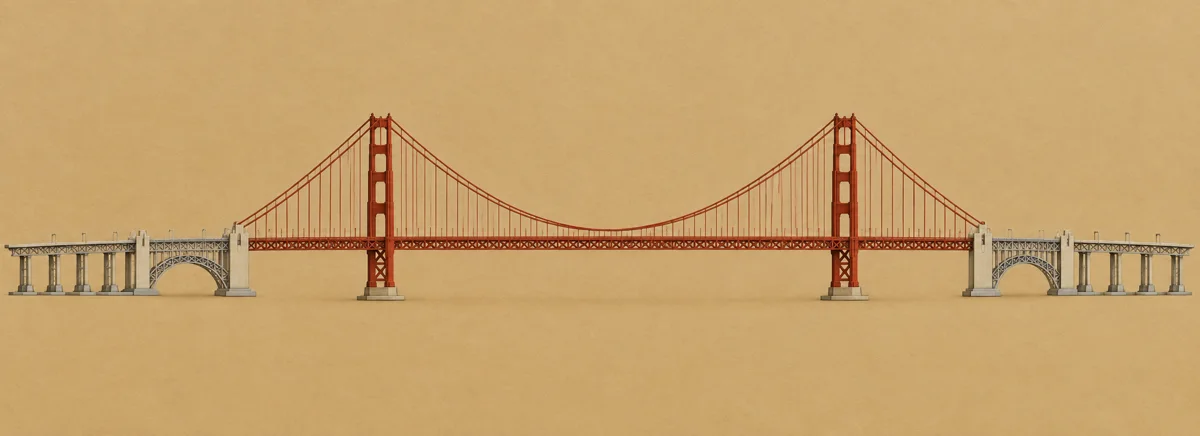
A photograph can show an entire bridge, but its most familiar number may describe only the opening between the main supports. The Golden Gate Bridge entry here uses the main span. The longer approach roads are not part of that answer.
Size It Up Landmarks names the span explicitly and uses measurement endpoints where the drawing also includes its supporting towers. Follow those endpoints rather than counting every visible pixel as measured length. The curved cable is not the line you are estimating.
A stadium has the same problem in another form: the building, the playing field and a roof arch have different dimensions. Wembley is represented by its named arch height. Nîmes, Verona and the Colosseum use the exterior long axis.
05 / Build a scale you can remember
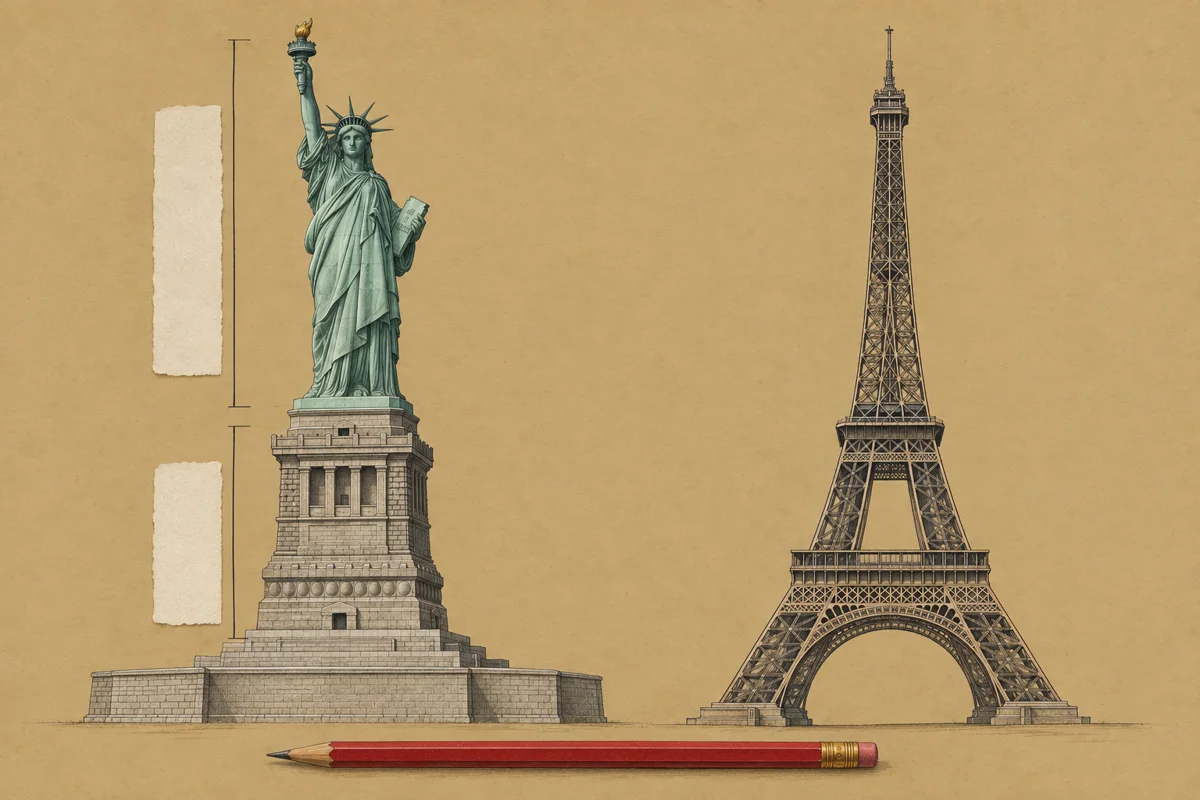
Use these worked examples to build anchors for later guesses in Size It Up Landmarks. The diagrams below use one common scale within each comparison. Their ratios are calculated from the object measurements, rather than estimated from the editorial illustrations.
These are permanent learning examples, not today’s answer list. Read the endpoints alongside each ratio: an accurate calculation still needs the right measurement definition.
The tower includes its antenna; Liberty includes her pedestal. Both use the same vertical scale from the base to the named top.
3.55× the named measurement
333 metres versus 330 metres: only three metres apart. Their different outlines can disguise how close their tip heights are.
1.01× the named measurement
The dimension lines run between tower centre lines. Side spans and approach roads are excluded.
2.63× the named measurement
06 / The collection
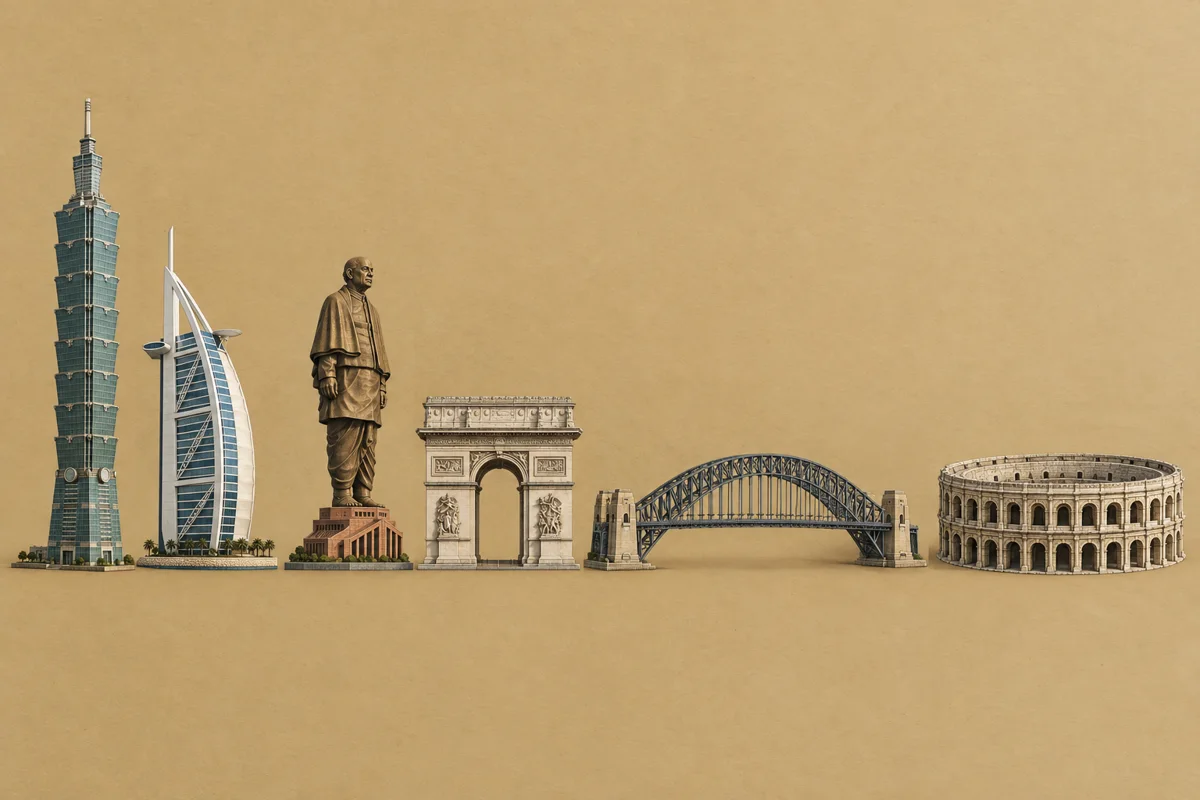
The Size It Up Landmarks collection contains 80 playable entries. Each card names the structure, the dimension and the source used for its size. Sizes are shown in metres and feet, with display rounding for readability.
Size It Up Landmarks includes modern towers and historic monuments, 21 bridge main spans and four arena-related structures. Each icon is fitted to its own box and is not drawn at a common scale.
2,023 m · 6,637 ft · length
Measurement source1,991 m · 6,532 ft · length
Measurement source1,624 m · 5,328 ft · length
Measurement source1,410 m · 4,626 ft · length
Measurement source1,377 m · 4,518 ft · length
Measurement source1,158.2 m · 3,800 ft · length
Measurement source1,100 m · 3,609 ft · length
Measurement source1,006 m · 3,301 ft · length
Measurement source990 m · 3,248 ft · length
Measurement source940 m · 3,084 ft · length
Measurement source876 m · 2,874 ft · length
Measurement source770 m · 2,526 ft · length
Measurement source600 m · 1,969 ft · length
Measurement source533.4 m · 1,750 ft · length
Measurement source487.7 m · 1,600 ft · length
Measurement source448.1 m · 1,470 ft · length
Measurement source214 m · 702 ft · length
Measurement source21 m · 69 ft · height
Measurement source07 / Train your eye
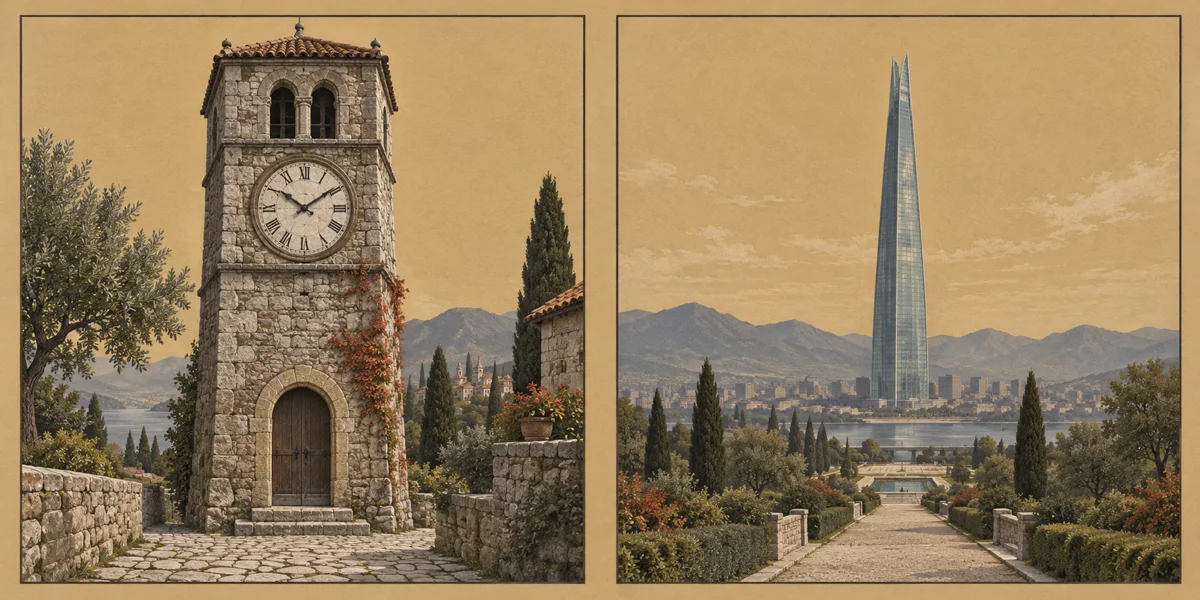
In Size It Up Landmarks, perspective makes a nearby monument look larger than a distant skyscraper. A low camera angle makes almost anything feel tall. Size It Up Landmarks removes the skyline and the camera distance so you can practise the actual size relationship.
Start with a landmark you know, then estimate a ratio. If the reference is about 100 metres high, ask whether the target feels closer to half, twice or five times that height. Adjust in broad steps first; tiny movements are useful only after your overall estimate is sensible.
In Size It Up Landmarks, a narrow outline is not necessarily a short object. Ignore how much ink fills the shape. Follow the labelled axis and take a moment to check whether a base or spire is included before committing.
08 / Behind the numbers
Size It Up Landmarks uses published structure measurements. Official monument operators, public authorities, architects and specialist building records are preferred. Every library card links to its measurement source so you can check the definition yourself.
Published values can be rounded or use different datums. Architectural height may include a spire while roof height does not; a monument’s figure and its pedestal are separate quantities. We preserve the selected definition and explain it instead of silently mixing incompatible values.
The artwork in Size It Up Landmarks is stylised. Suspension bridges share structural schematics; only the labelled main span is measured, while tower heights and cable details are illustrative. Editorial illustrations help explain ideas; only the game’s measured dimension and the calculated comparison diagrams determine scale. If a source or silhouette looks wrong, send feedback with the object name and the measurement you expected.
09 / Questions from the field
10 / Keep exploring
Keep practising in Size It Up Landmarks Unlimited, or change subjects to see how well your sense of scale transfers. Animals, geography and everyday objects each test a different set of visual assumptions.